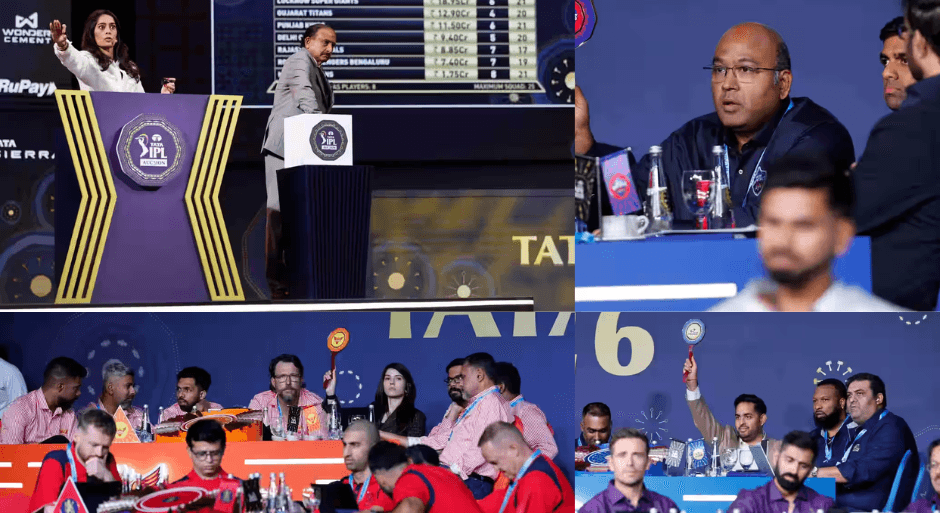
The IPL 2026 auction was not about star power alone. It was about intent. Across 77 players and ₹215.45 crore spent, the 10 franchises revealed a league in transition—one that is increasingly driven by role clarity, domestic pipelines, and future-facing investments rather than reputation or past glories. Two teams stood at the centre of this shift: Kolkata Knight Riders (KKR) and Chennai Super Kings (CSK). Both entered the auction with deep purses and left with vastly different squads, shaped by sharply contrasting philosophies.
KKR: Replacing Impact, Not Names
KKR were aggressive and unapologetic. Three of the six most expensive buys came from their table, headlined by Cameron Green at ₹25.20 crore—the costliest player of the auction and now the third-most expensive in IPL history.
Green’s signing was less about hype and more about succession planning. With Andre Russell retired, KKR needed a player who could bat with brute force and still offer meaningful overs. Green fits that template almost perfectly, and KKR were willing to outbid CSK to secure him.
More intriguing, however, was their move for Matheesha Pathirana at ₹18 crore. Coming off a poor IPL 2025, Pathirana’s price raised eyebrows. But KKR are clearly betting on skill retention over recent form, viewing the Sri Lankan as a long-term death-overs asset—another role once owned by Russell.
Add Mustafizur Rahman, Akash Deep, and Kartik Tyagi to a pace unit already featuring Harshit Rana, Vaibhav Arora, and Umran Malik, and KKR’s thinking becomes clear: dominate the back end of innings, with both bat and ball.
CSK: The Youth Pivot Is Real
CSK, traditionally associated with experience and continuity, leaned hard into youth.
After a disastrous start to IPL 2025 forced mid-season changes, the franchise has clearly embraced a philosophical reset. This auction confirmed it.
Instead of chasing established names, CSK poured money into uncapped Indian players. Uttar Pradesh all-rounder Prashant Veer and Rajasthan wicketkeeper-batter Kartik Sharma both fetched ₹14.20 crore—the highest-ever auction price for uncapped players.
Prashant, just 20, profiles as a long-term replacement for Ravindra Jadeja, who was traded away earlier. Kartik’s signing, meanwhile, gives CSK an embarrassment of riches behind the stumps, with Sanju Samson, Urvil Patel, MS Dhoni, and now Kartik all in the squad.
It’s a gamble—but a calculated one. CSK are no longer planning for the next season alone; they’re planning for the next cycle.
Domestic Pace: The New Gold
One of the strongest themes of the auction was the premium placed on Indian fast bowlers.
Delhi Capitals snapped up Jammu & Kashmir pacer Auqib Nabi for ₹8.4 crore, rewarding his red-ball consistency and improving death-bowling skills. Royal Challengers Bengaluru followed a similar path, signing left-arm quick Mangesh Yadav for ₹5.20 crore.
In contrast, overseas batters were treated cautiously. Big names like Liam Livingstone, Devon Conway, and Jake Fraser-McGurk went unsold initially, a rare sight in previous seasons. Livingstone eventually found a buyer, but the early message was unmistakable: overseas slots are no longer default star positions.
Reputation No Longer Pays
Perhaps the most telling aspect of the auction was who lost value.
Capped Indian players not in current national plans were largely ignored. Six of nine capped Indians were sold at base price. Even recent Test regulars like Akash Deep failed to trigger bidding wars.
Venkatesh Iyer and Ravi Bishnoi—once marquee names—saw dramatic drops in valuation, underlining the IPL’s unforgiving reality: form, fit, and future matter more than memory.
The same fate befell Prithvi Shaw and Sarfaraz Khan, both picked up only after re-runs and at base price. The league has little patience for stalled trajectories.
State T20 Leagues: The New Pipeline
The real winners of the auction were India’s State T20 leagues.
Thirty-two uncapped Indian players earned contracts, with ₹63.45 crore spent on them—nearly three-quarters of the total Indian spend. Many were already well scouted thanks to performances in leagues like the UP T20 League, MP Premier League, and Delhi Premier League.
Names like Prashant Veer, Akshat Raghuwanshi, Mangesh Yadav, and Naman Tiwari weren’t surprises on auction day—they were planned investments.
As scoring rates soar, pitches flatten, and bowlers operate on razor-thin margins, franchises are prioritising specialists built for modern T20 chaos over players shaped by longer formats.
A League That Keeps Evolving
The IPL 2026 auction made one thing clear: the league is no longer just a reward system for established talent. It is a marketplace for roles, skills, and potential.
If this new crop of T20-first players succeeds, the IPL will further cement itself not just as the world’s richest league—but as the most influential talent pathway in modern cricket.
And in that sense, the auction wasn’t just about buying players. It was about buying the future.