You land in the US after a 16-hour flight. You are exhausted. You need a cab, food, maybe a temporary hotel stay.
But your Indian debit card is declining. Your international transaction limit is blocked. You are carrying limited cash. And your US bank account does not exist yet. For thousands of Indian students, this is a real first-week nightmare.
Traditional US banking often requires physical presence, a Social Security Number, and a local US address. That makes things stressful if you wait until after arrival. The good news is this.
Several banks and fintech platforms now allow Indian students to open US bank accounts before they even board the flight. Having your US account ready means immediate access to funds for housing, groceries, tuition payments, and emergencies.
Without proper banking setup, your initial fund transfers could face delays or even be blocked. Planning ahead prevents this stressful scenario, as explained in this detailed [Could Your International Transfer Be Blocked? Real Security Risks NRIs Face and How to Fix Them] guide. This step-by-step guide walks you through everything. From India to landing in the US with a fully functional bank account.
Why Open a US Bank Account Before You Arrive?
Immediate Financial Access Upon Landing
With a pre-opened account, you can:
- Pay for Uber or Lyft from the airport
- Buy groceries immediately
- Access emergency funds
- Avoid waiting days for activation
Your financial life starts on day one.
Avoid Carrying Large Cash Amounts
Carrying more than $10,000 requires declaration at US customs. Cash also exposes you to theft risks.
And physical currency often gives poor exchange rates. Digital transfers are safer and smarter.
Easier Apartment and Utility Setup
Many landlords prefer US bank accounts. Security deposits and rent payments are easier.
Utility companies often require US payment methods. You also begin building your US credit profile early.
Simplified Tuition and Fee Payments
Direct payment from US accounts reduces repeated international wire fees. It also simplifies refund handling from universities.
Most international students report financial setup as their number one stress factor in the first week. Pre-arrival banking removes this pressure completely.
Pre-Arrival Banking Options for Indian Students
Option 1: Banks with International Student Programs
Some major US banks offer student-friendly options.
| Bank | Program | Key Feature |
|---|---|---|
| Bank of America | Student Banking | Pre-arrival with I-20 |
| Wells Fargo | International Student Account | No SSN initially |
| Chase | College Checking | Campus partnerships |
| Citibank | Student Account | Global transfer benefits |
These banks often allow opening with passport and I-20.
Option 2: Digital Banks and Neobanks
Platforms like Wise, Mercury, and Payoneer offer faster onboarding.
Benefits include:
- Lower fees
- Faster setup
- Multi-currency features
These solutions represent the evolution of integrated banking experiences described in this practical [Embedded Finance: How It’s Making NRI Banking More Seamless Than Ever] guide.
Option 3: University-Partnered Banking
Many universities partner with specific banks.
Advantages include:
- On-campus branches
- Student-specific benefits
- Easier verification
Check your International Student Office before applying independently.
Comparison: Traditional vs Digital
Traditional banks offer long-term credibility. Digital banks offer speed and flexibility.
Choose based on your future plans, including internships, credit building, and post-study settlement.
Step-by-Step Guide to Opening Your US Account from India
Step 1: Gather Required Documents
Prepare:
- Valid passport with US visa
- Form I-20
- University admission letter
- Indian address proof
- PAN card
- Contact details
Having documents ready speeds approval.
Step 2: Choose Your Bank
Compare:
- Monthly fees
- Minimum balance requirements
- ATM access
- International transfer support
Think long term, not just convenience.
Step 3: Complete Online Application
- Fill the application form.
- Upload documents.
- Complete video verification if required.
- Sign agreements digitally.
Step 4: Account Verification
Approval typically takes 3 to 7 business days. You receive your account number and routing number. Activate online banking immediately.
Step 5: Receive Debit Card
Options include:
- Ship to Indian address
- Collect at US branch
- Activate virtual card instantly
Step 6: Fund Your Account
Transfer funds from India. Link Indian bank for future transfers. Set up recurring transfers if required.
Funding Your US Account from India
Understanding RBI’s LRS
Under RBI’s Liberalised Remittance Scheme, you can remit up to USD 250,000 per financial year. Education qualifies under LRS.
You must complete Form A2 and provide supporting documents.
Purpose Codes for Education Transfers
Correct purpose codes ensure smooth processing. Education transfers have specific codes.
Incorrect coding is one of the biggest causes of delays, as explained in this helpful [What NRIs Need to Know About RBI’s Purpose Codes for Inward Remittances] guide.
Best Methods for Initial Funding
Options include:
- Bank wire transfer
- Authorized forex providers
- Digital platforms like Wise
Compare fees and exchange rates carefully.
What If Your Transfer Gets Stuck?
Common reasons include documentation mismatch and compliance holds. Lost or delayed transfers happen, and knowing recovery steps in advance helps, as covered in this practical [What Happens If Your Transfer Is Lost? Stories and Solutions for NRIs] guide.
Large first-time transfers sometimes trigger security flags. Proper documentation reduces block risks, as explained in this detailed [Could Your International Transfer Be Blocked? Real Security Risks NRIs Face and How to Fix Them] resource.
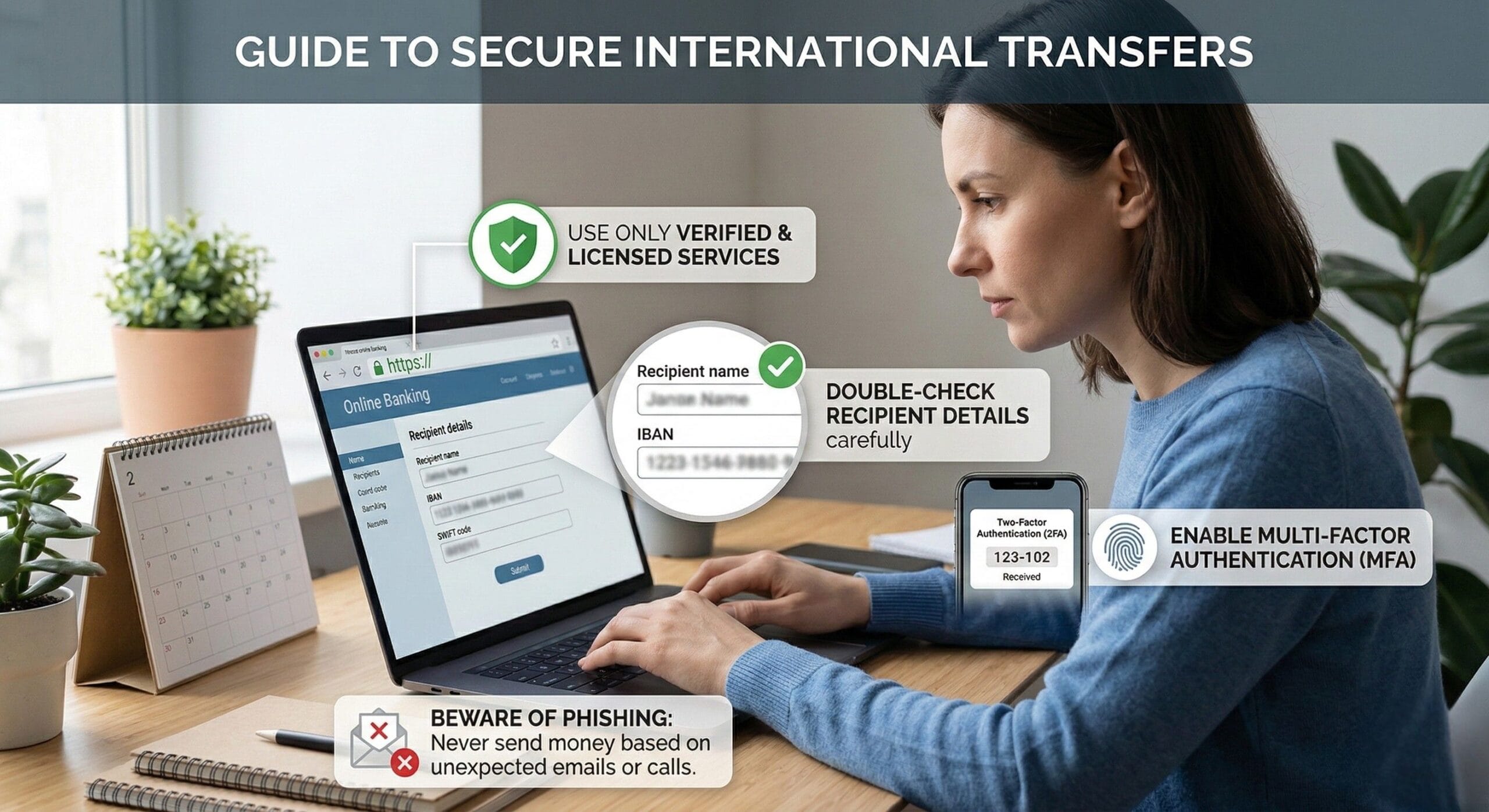
Security Essentials: Protecting Your New Account
Setting Up Account Security
- Enable two-factor authentication.
- Create strong passwords.
- Turn on transaction alerts.
- Register for fraud monitoring.
Scams Targeting International Students
Be aware of:
- Fake tuition payment emails
- Housing deposit scams
- Job offer scams requiring deposits
- IRS impersonation calls
International students are prime targets, so understanding scam tactics early is crucial, as detailed in this practical [How to Prevent Fraud and Protect Your Money During International Transfers] guide.
How Banks Protect You
Banks use automated monitoring. Suspicious transactions trigger alerts. Modern systems rely on compliance automation, explained clearly in this [Understanding RegTech: How Regulatory Tech Keeps NRI Transfers Safe and Compliant] guide.
Safe Banking Practices
- Never share OTPs.
- Verify unusual requests independently.
- Avoid public WiFi for banking.
- Monitor transactions regularly.
Tax Implications Every Student Must Know
Your Changing Tax Status
- F-1 students are initially non-resident aliens.
- After meeting the Substantial Presence Test, status may change.
- This affects filing requirements.
- Understanding FBAR and FATCA
If you become a US tax resident, your Indian accounts may become reportable. Early awareness prevents penalties, as explained in this detailed [Avoiding US Penalties and Double Taxation: A US-NRI’s Guide to FBAR & FATCA] guide.
The 120-Day Rule and Indian Tax Residency
Frequent long visits to India can impact tax status. Exceeding certain thresholds may change your residency classification, as explained in this comprehensive [The 120-Day Rule for NRIs: Are You Accidentally a Tax Resident of India?] resource.
Keep Records From Day One
Maintain documentation for both US and Indian compliance. Organized records reduce future stress.
After Arrival: First Week Banking Checklist
Day 1-3
- Activate debit card.
- Download mobile app.
- Test small withdrawal.
- Save customer support number.
Day 4-7
- Visit branch if required.
- Apply for SSN if eligible.
- Update US address.
- Set up direct deposit.
First Month
- Evaluate bank performance.
- Set up automatic savings.
- Review fees.
Common Mistakes to Avoid
Pre-Arrival Mistakes
- Waiting too late.
- Ignoring verification steps.
- Carrying excessive cash.
- Ignoring purpose codes.
Post-Arrival Mistakes
- Sharing banking details.
- Falling for unrealistic offers.
- Ignoring account alerts.
Long-Term Mistakes
- Not tracking tax status.
- Ignoring reporting requirements.
- Not building credit.
Conclusion
Opening a US bank account before arrival is possible and highly recommended. Gather documents early. Choose your bank carefully. Complete online verification. Fund your account properly. Secure it with strong safety measures. Thousands of Indian students do this successfully every year. You can too.
With your banking set up properly, you avoid the stress of blocked transfers and financial uncertainty, as explained in this detailed [Could Your International Transfer Be Blocked? Real Security Risks NRIs Face and How to Fix Them] guide. start at least 4 to 6 weeks before departure. Check your university’s banking partnerships today.
Frequently Asked Questions
Q1: Can I open a US bank account without an SSN?
Yes. Many banks allow F-1 students to open accounts using passport and I-20.
Q2: How long does approval take?
Typically 3 to 7 business days.
Q3: What is the minimum deposit?
Varies by bank. Some require none. Others require $25 to $100.
Q4: Can parents send money directly?
Yes. Through wire transfer or digital services under LRS guidelines.
Q5: Should I close my Indian bank account?
No. Maintain at least one NRE or NRO account for future needs.