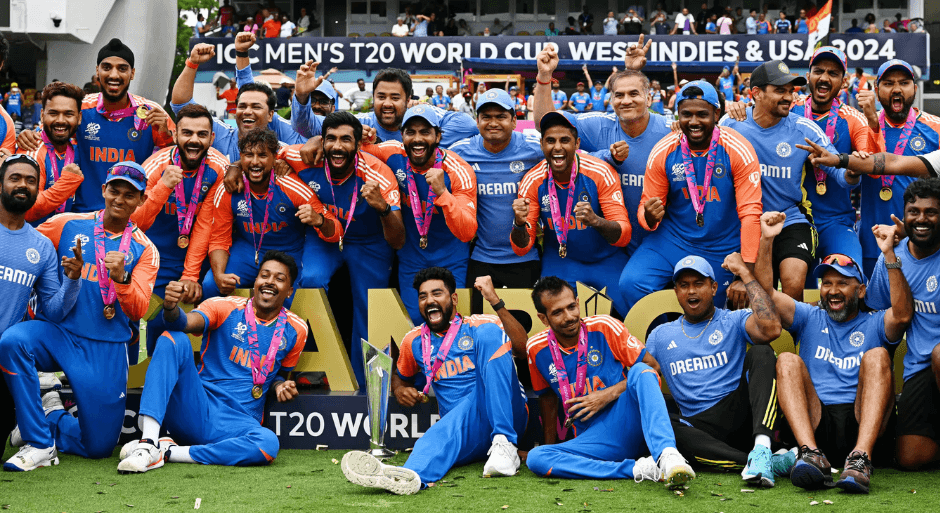
As India marches toward the 2026 ICC Men’s T20 World Cup, the countdown has become very real. After wrapping up the five-match series in Australia with a 2–1 win — and with the final game washed out — the team now stands just 10 home T20Is away from finalising their blueprint for a title defense.
In many ways, India are entering this phase from a position of strength. With seven consecutive T20I series wins, including the Asia Cup 2025, Gautam Gambhir’s side has found rhythm, depth and a core group of match-winners. Abhishek Sharma has been a revelation, the spinners have dictated terms, and the team’s confidence at home is unmistakable.
Yet champagne stats often hide uncomfortable truths. Beneath the surface, there are selection dilemmas, form worries, and tactical imbalances that cannot be ignored — not with the World Cup on home soil, not with a title to defend.
Here are the biggest questions India must answer in the final 10 games before February 2026.
Is Suryakumar Yadav’s Captaincy Affecting His Batting?
Suryakumar Yadav continues to strike at elite levels — 171.42 in the recent Australia series — but the substance behind the numbers tells a different story. After scores of 39, 1, 24, and 20, the problem is not impact but conversion. His Asia Cup was below-par, and since the 2024 World Cup he averages 19.71 in 24 innings.
It is clear that leadership has tightened his expression as a batter. India’s flexible middle-order combinations have hidden his dip so far — but in a World Cup knockout, flexibility does not guarantee cover.Possible solution?Drop SKY to No. 6 as a finisher, allowing Tilak Varma or the wicketkeeper to take No. 3/4. The next 10 matches will determine whether SKY walks into the World Cup as a captain in form — or a captain carried by the team.
The Shubman Gill Dilemma: Talent vs T20 Fit
Shubman Gill’s re-integration has unsettled India’s otherwise settled T20 structure.
Gill is India’s vice-captain for the World Cup and widely seen as the long-term leader. But in the shortest format, his returns have been modest. Since his Asia Cup comeback, he has no fifties, and the balance has visibly shifted. The issue isn’t just failure — it’s tempo.
When Gill plays long, his strike rate slows. When he accelerates early, he gets out. His 46 in the 4th T20I came at 117.94, well below modern T20 expectations.
And his inclusion has created a ripple effect:
Yashasvi Jaiswal is benched
Samson is pushed into the middle-order
Shifting roles have affected cohesion
Arshdeep Singh has occasionally lost his spot to maintain balance
India now must decide:Is Gill an opener locked in for form, or for future leadership? These 10 home matches will define whether India are adjusting to Gill — or Gill adjusts to the demands of this format.
Samson or Jitesh? India Still Don’t Know Their T20 World Cup Wicketkeeper
This is perhaps the biggest unresolved call.
Since the 2024 T20 World Cup:
Samson has played 26 matches
Jurel 4
Jitesh 3
Pant 2
Yet no one has cemented the role.
Samson looked like India’s preferred option. In the top order he is destructive — strike rate 169.30 with three hundreds — but the moment Gill returned, Samson was pushed to 4, 5, 6, even 7. His returns dipped drastically (strike rate 129.20).
Former selector Krishnamachari Srikkanth summed it up bluntly:
“You are destroying his confidence. No one succeeds with musical-chairs batting positions.”
Jitesh Sharma, however, is a pure lower-order hitter. His brief knockout cameo (22 off 13 at No. 7) showed exactly the role he fulfills — a role Samson does not naturally fit.
The question is now clarity vs talent:Does India want a role-based wicketkeeper, or a high-ceiling batter?
The next 10 T20Is will decide that — and it could define India’s finishing strength in the World Cup.
Where Does Rinku Singh Fit in This Puzzle?
If Gill’s inclusion complicates the opening slot, the fallout hits the finishing role.The biggest casualty? Rinku Singh.
Since Gill returned, Rinku has played only two games — often not getting to bat at all. The man who was India’s best finisher between 2023–24 has become a backup option again, just as he was in the last T20 World Cup squad.
Unless an injury occurs — or unless India moves on from the Gill-SKY middle-order block — Rinku risks missing out again. The team has floated an alternative: Nitish Kumar Reddy, a seam-bowling all-rounder who covers Hardik Pandya’s injury-risk profile. But the question persists: Is India walking away from their most reliable finisher too soon?
Washington Sundar: Too Good to Ignore, But No Space to Play?
Whenever he plays, he performs:
A 49 with the bat in the 3rd T20 in Australia
3 wickets in 8 balls in the 4th T20
Yet India’s spin department is overloaded:
Kuldeep Yadav (guaranteed starter)
Axar Patel (undroppable all-rounder)
Varun Chakaravarthy (excellent form)
Where does Sundar fit?Playing him means dropping one of the above or breaking the team structure.
The only way he makes the XI consistently is:
If India go spin-heavy on home pitches
Or if Sundar is backed as a No. 6/7 “bat-spin utility” player
The South Africa and New Zealand series will reveal whether Gambhir sees Sundar as a rotation option — or a genuine World Cup contender.
How Many All-Rounders Is Too Many?
Gambhir has made no secret of his love for multi-skill players. Axar, Hardik, Abhishek, Dube, Nitish Reddy, Washington… the list grows. The strength is clear: flexibility. But the risk is also real:Does India have enough “specialists”? A T20 World Cup at home might reward all-round depth, but at some point, match-winners matter more than balance. Overloading on all-rounders can dilute roles — something India must monitor carefully.
Has the Middle Order Found Its True Structure?
India’s middle order shifts every game:
SKY moves between 3 and 4
Tilak rotates between 3, 4, and 5
Samson bounces between 3 to 7
Dube floats
Hardik is sometimes 5, sometimes 6
This kind of fluidity helps in bilateral series. In a World Cup knockout? It can cause chaos.
The most important question India must answer is simple:What is the fixed template for overs 7–15? Because that phase decides World Cup matches.
What Is India’s Best XI on a Slow, Turning World Cup Pitch?
India’s home pitches will vary — but many will assist turn. In such conditions:
Does India play three spinners?
Does Hardik bowl consistently?
Is there space for only one of Dube or Rinku?
Do they trust the Gill-Abhishek pairing as openers?
A wrong call here could cost the team the semifinal or the final.
Are India Ready to Handle Home Pressure?
This cannot be overstated.
Playing a home World Cup brings:
Media storms
Selection scrutiny
Over-analysis
Noise around every decision
SKY is still learning as captain. Gill is stepping into leadership too. Hardik is returning from injury patterns. Gambhir is coaching India for his first ICC event. This is the moment India must not just prepare technically — but emotionally.
Players in the 2026 T20 WC Race (Updated Summary)
Confirmed
Suryakumar Yadav (C), Gill (VC), Bumrah, Arshdeep, Abhishek, Tilak, Hardik, Axar, Kuldeep, Varun Chakaravarthy, Shivam Dube
Most Likely
Samson, Jitesh, Sundar, Rinku Singh, Nitish Reddy, Harshit Rana
Outside Chance
Shreyas Iyer, Jaiswal, Siraj, Sudharsan, Pant, Jurel, Riyan Parag, Prasidh Krishna, KL Rahul
India are not in crisis — far from it. They are winning, experimenting smartly, and building depth. But World Cups expose even the smallest cracks. The last 10 matches before the 2026 T20 World Cup will determine whether India walk into their home tournament as favourites — or as a team still searching for answers.